What Is London
Ballroom Skating?
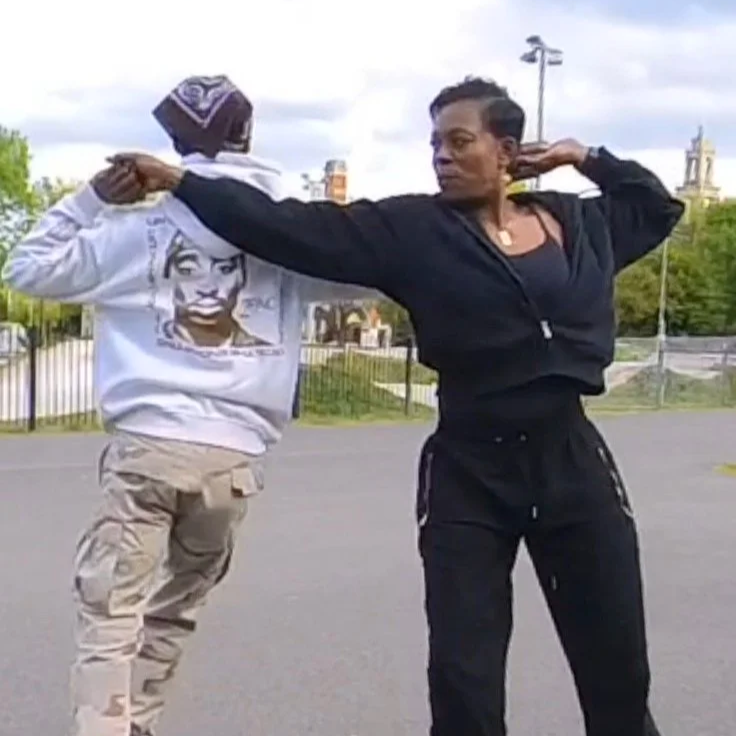
London Ballroom Skating is a modern, UK‑rooted interpretation of ballroom skating that has developed within London’s urban skate community. It combines partnered dance, musical interpretation, and smooth technical skating, while responding to the realities of London’s music culture, skating spaces, and surfaces.
While London Ballroom Skating is informed by long‑established American ballroom skating traditions—particularly those originating in St. Louis—it is not an attempt to replicate them. Instead, it represents a newer style that applies ballroom principles in ways that suit London’s environment and evolving skate culture.
-
Ballroom roller skating originated as a partner‑based social dance on skates, developed in roller rinks where skaters moved together to music with an emphasis on connection, rhythm, and smoothness rather than tricks or speed.
Across different regions, ballroom skating evolved in slightly different ways, but shared core principles:
Partner connection and communication
Lead–follow dynamics
Continuous, gliding movement
Musical timing and phrasing
Clean edges, posture, and balance
Over time, some ballroom skating communities –particularly in the United States – developed strong stylistic lineages, where techniques, steps, and movement concepts were passed down through teaching, observation, and shared practice.
-
London Ballroom Skating builds on these foundational ballroom principles while adapting them to a different context.
As ballroom skating began to grow in London, skaters were learning in a city with:
Fewer large, permanent roller rinks
A strong outdoor skating culture
Diverse musical influences
Skaters arriving from freestyle, rhythm, and social skating backgrounds
Rather than inheriting a single, established set of patterns, London skaters focused on understanding how ballroom works, then applying those ideas in ways that felt practical and musical in London spaces.
-
In some long‑established ballroom skating traditions, movement is often taught through recognised patterns and sequences that have been refined over many years. These patterns provide consistency, clarity, and a strong sense of heritage.
London Ballroom Skating takes a slightly different approach. The emphasis is on:
Understanding momentum, edges, and body alignment
Maintaining flow and continuity between movements
Responding to music and partner connection in real time
Rather than memorising set sequences, skaters learn principles that allow movements to adapt naturally to the music, partner, and space.
-
Item desA defining characteristic of London Ballroom Skating is its use of push and pull within partnered movement.
Because much of London skating takes place on:
Outdoor concrete
Park pathways
Multi‑use urban surfaces
skaters often need to generate and manage their own momentum. Push and pull actions between partners help to:
Create smooth forward motion on rougher ground
Maintain flow without relying on rink‑smooth surfaces
Support balance and timing outdoors
This results in movement that may appear more grounded and dynamic, with momentum being actively created rather than assumed.
-
London Ballroom Skating reflects the city’s wide musical landscape. While classic soul and R&B remain important, skaters regularly move to:
Neo‑soul and contemporary R&B
UK‑influenced tracks
Afrobeats or Amapiano
Slower or more atmospheric music that supports connection and control
The focus remains on musical interpretation—allowing timing, phrasing, and emotion to guide the movement rather than fitting music to predetermined steps.
-
London Ballroom Skating places strong value on mutual awareness between partners. While lead–follow roles are paramount, they are often expressed with flexibility, allowing both skaters to contribute to timing, momentum, and expression (for example, follower adds a 4 beat crazy leg).
This approach reflects the inclusive, social nature of London’s skating community and supports skaters of different experience levels dancing together comfortably.
-
Well‑known ballroom skating styles such as St. Louis ballroom are respected for their history, refinement, and technical depth. London Ballroom Skating does not seek to replace or redefine these traditions.
Instead, it exists as a parallel development—a newer style shaped by different environments, surfaces, and cultural influences, while remaining rooted in the same ballroom foundations of connection, musicality, and flow.
-
London Ballroom Skating is well suited to:
Beginners interested in partner roller skating
Skaters transitioning from freestyle or rhythm skating
Dancers exploring skating as a partnered movement form
Couples looking for a shared social skating practice
No competitive background is required. The emphasis is on learning, connection, and community.
-
Today, London Ballroom Skating continues to develop organically. It is shaped by the skaters who practise it, the music played at sessions, and the environments—indoor and outdoor—in which it is danced.
Rooted in ballroom tradition but responsive to London life, it remains an open, evolving, and community‑led style.